
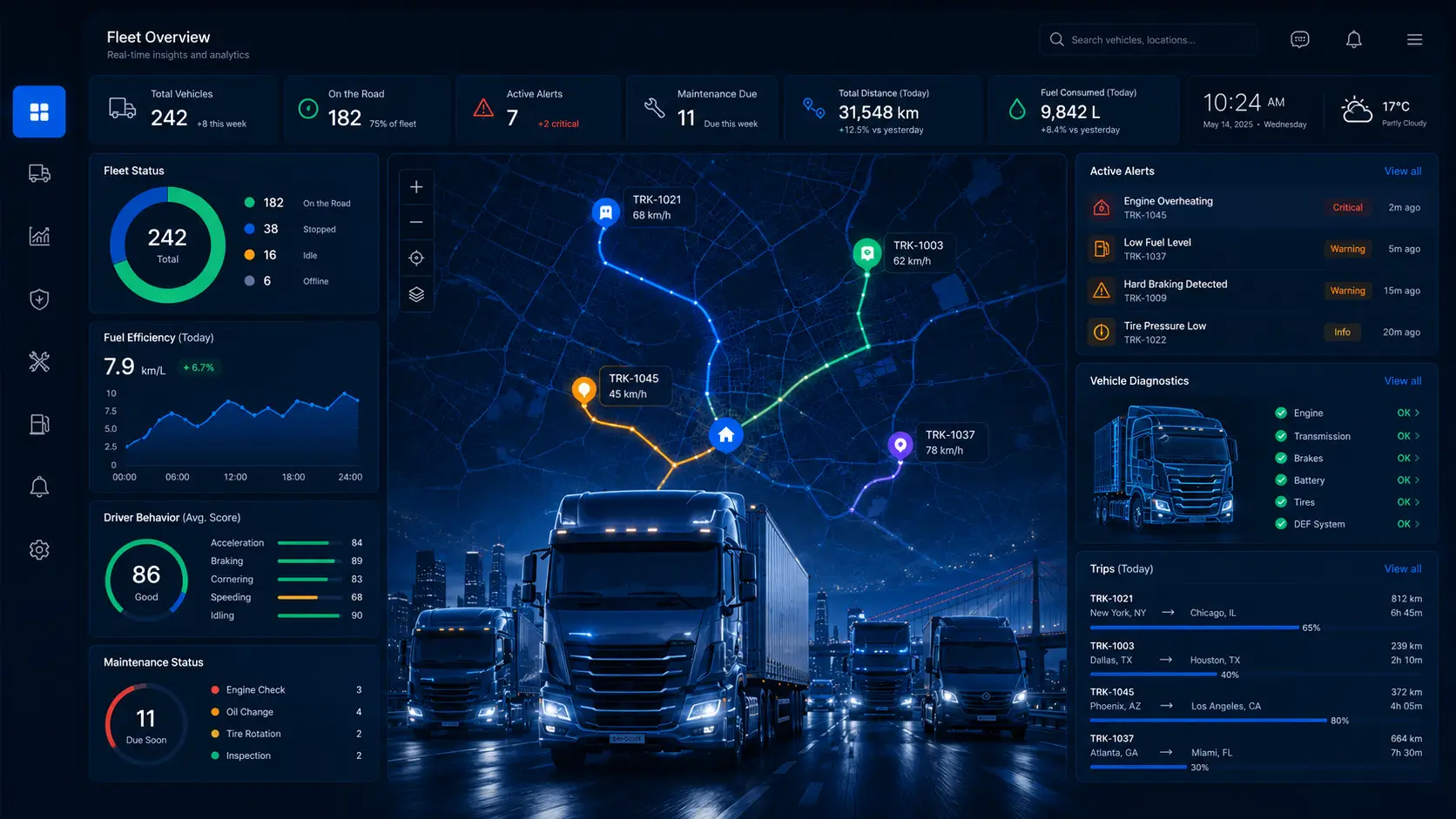
Telematics is a technology that helps companies collect and use vehicle data for better fleet management. In practice, vehicle telematics combines GPS tracking, onboard diagnostics, sensors, connectivity, and software to show where vehicles are, how they are used, how drivers behave, and what is happening with fuel, safety, and vehicle health.
For commercial fleets, telematics is no longer just a way to see a vehicle on a map. It is a data layer that supports daily operational decisions: dispatching vehicles, monitoring fuel usage, detecting risky driving, planning maintenance, confirming completed routes, and reducing manual reporting.
This guide explains how telematics works, what data it collects, and how fleets use it to improve visibility, fuel control, safety, and maintenance.
What Is Telematics?
Telematics is the use of telecommunications, GPS, sensors, onboard diagnostics, and software to collect and analyze data from vehicles, equipment, and remote assets. In fleet management, telematics helps companies monitor location, fuel, driver behavior, vehicle health, safety events, and operational performance in real time.
The word telematics comes from two ideas: telecommunications and informatics. In simple terms, it means that data is collected from a remote object, transmitted through a communication network, and then processed in software so people can understand and use it.
In a business context, telematics is most often connected with vehicle telematics and fleet telematics. Companies use it to monitor cars, trucks, buses, trailers, heavy equipment, containers, and other mobile assets. The system may start with basic GPS location data, but it can also include fuel level, engine diagnostics, driver behavior, temperature, tire pressure, video events, and other sensor readings.
In road transport, telematics is closely connected with intelligent transport systems. The Australian Government Department of Infrastructure describes ITS as the use of information and communications technologies to manage transport systems, collect and communicate road-condition data, and help transport managers and road users make more informed decisions.
This is why telematics is important for modern fleets. It turns separate vehicles and assets into a connected operational system where managers can see what is happening, respond faster, and make decisions based on data rather than assumptions.
For a quick visual overview, watch this short video explaining what telematics is, how it works, and how businesses use vehicle data for fleet management.
What Is Vehicle Telematics?
Vehicle telematics is a practical application of telematics technology for cars, trucks, buses, trailers, and specialized equipment. It collects data from the vehicle, connected sensors, and telematics devices, then sends this information to a software platform where fleet managers can monitor vehicles, trips, alerts, fuel usage, events, reports, driver behavior, and technical status.
A vehicle telematics system can combine GPS/GNSS, OBD-II, CAN bus, fuel and temperature sensors, tire sensors, driver ID devices, and cameras.
This makes vehicle telematics broader than basic location tracking. GPS tracking equipment shows where a vehicle is and where it has been, but a full telematics system can also help identify excessive idling, harsh braking, abnormal fuel consumption, fault codes, maintenance needs, route deviations, and safety-related events.
For example, a fleet manager can check route completion, unscheduled stops, abnormal fuel use, or diagnostic warnings. In advanced projects, this data can also connect with dispatching systems, ERP, BI dashboards, or custom IoT applications.
How Does a Telematics System Work?
A telematics system works by collecting data from a vehicle through GPS, OBD-II, CAN bus, sensors, or cameras. A telematics device transmits this data through a cellular or satellite network to cloud software, where fleet managers can view maps, alerts, reports, dashboards, and analytics.

1. Data is collected from the vehicle or asset
The process starts with data collection. A telematics device is installed in or connected to the vehicle, trailer, machine, or remote asset. Depending on the project, it can collect information from several sources at the same time.
Common data sources include:
- GPS/GNSS modules for location, movement, routes, stops, and geofences;
- OBD-II and CAN bus for diagnostics, mileage, RPM, fuel consumption, and engine data;
- accelerometers for harsh braking, acceleration, cornering, and impact detection;
- fuel, temperature, and tire sensors for fuel level, cargo/tank temperature, tire pressure, and abnormal events;
- cameras and video telematics devices for road-facing events, driver-facing events, and incident evidence;
- driver identification devices for linking vehicle activity to a specific driver;
- external equipment sensors for trailers, machinery, cargo, or specialized assets.
Depending on the fleet’s tasks, a telematics system can combine GPS tracking equipment, fuel monitoring sensors, and video telematics equipment into one operational system.
2. The telematics device transmits data
After data is collected, the telematics device sends it to a software platform. Most fleet telematics systems use cellular networks. Satellite connectivity may be used for remote areas or specific operating conditions.
Some devices can also use Wi-Fi or Bluetooth for local data transfer, configuration, or connection with additional sensors. If the connection is temporarily unavailable, the device may store data in internal memory and transmit it later.
3. Software processes and visualizes the data
Telematics software turns raw vehicle data into information that fleet managers can use. Instead of separate sensor values, users see:
- live maps and route history;
- alerts for speeding, route deviation, fuel drains, and geofence events;
- fuel reports, driver scores, and diagnostic warnings;
- maintenance reminders;
- dashboards and reports for operations, safety, fuel control, maintenance, and compliance.
This is where telematics becomes useful for fleet management: the system makes vehicle data visible, structured, and actionable.
4. Fleet managers use insights to make decisions
Fleet managers use telematics data to respond faster and reduce manual reporting. For example, they can:
- adjust routes or contact drivers;
- detect fuel drains or abnormal consumption;
- schedule maintenance before downtime occurs;
- investigate accidents or disputed incidents;
- confirm delivery, service visits, or route completion.
A fleet telematics system is therefore not only a monitoring tool. It helps companies make operational decisions based on real-time and historical vehicle data.
What Data Does Telematics Collect?
A telematics system can collect different types of data depending on the vehicle, installed hardware, sensors, software platform, and business goals. A small fleet may only need GPS location, trips, mileage, and basic alerts. A more complex commercial fleet may also need CAN bus data, fuel monitoring, video telematics, temperature control, tire monitoring, and external equipment sensors.
Data type | Examples | Why it matters |
Location data | GPS position, routes, stops, geofences | Dispatching, route control, theft prevention, proof of service |
Vehicle activity | Mileage, speed, ignition, movement, engine hours | Utilization, planning, and operational control |
Driver behavior | Harsh braking, acceleration, cornering, speeding, idling | Safety, coaching, and risk reduction |
Fuel data | Fuel level, consumption, refueling, drains | Fuel cost control and loss detection |
Diagnostics | DTCs, engine status, battery, RPM, temperature | Maintenance planning and downtime reduction |
Video data | Road-facing events, driver-facing events, incident footage | Evidence, safety, and event investigation |
Sensor data | Tire pressure, tire temperature, cargo temperature, tank temperature, load | Specialized control for trailers, tanks, cold chain, and equipment |
Operational events | Geofence entry/exit, route completion, unauthorized use, alerts | Faster response to exceptions and better reporting |

The right telematics data set depends on the business problem: delivery, fuel transportation, construction, and cold chain fleets usually need different combinations of tracking, fuel, diagnostics, video, and sensor data.
That is why a telematics system should be designed around operational goals, not around the longest possible feature list.
Telematics vs Fleet Management Software
Telematics and fleet management software are closely connected, but they are not the same thing. Telematics is the technology and data flow: devices, sensors, GPS, CAN bus, connectivity, and vehicle data. Fleet management software is the platform where this data is used to manage vehicles, drivers, routes, fuel, maintenance, safety, and reports.
Telematics provides the data. Fleet management software helps turn that data into operational decisions.
This is why fleet management telematics is usually not just about installing a tracker. It also requires the right software platform, reports, alerts, user roles, dashboards, and integrations. Depending on the fleet’s needs, TAI Capital can work with Wialon fleet management solutions and the Titan fleet management platform to build a system around tracking, fuel control, safety, maintenance, and operational analytics.
Telematics vs GPS Tracking: What’s the Difference?
GPS tracking is a part of telematics, but telematics is broader. GPS tracking shows where a vehicle is, while telematics can also monitor fuel, driver behavior, diagnostics, maintenance, safety events, and sensor data.
Many companies start with GPS fleet tracking because they need visibility: where vehicles are, where they have been, and whether routes are being followed. A full telematics system goes further. It connects location data with vehicle activity, technical condition, fuel usage, driver behavior, alerts, and reports.
Feature | GPS tracking | Telematics |
Real-time location | Yes | Yes |
Route history | Yes | Yes |
Engine diagnostics | Usually no | Yes |
Fuel monitoring | Limited or no | Yes, with sensors or integration |
Driver behavior | Limited | Yes |
Maintenance alerts | No or limited | Yes |
Reports and analytics | Basic | Advanced |
Integration with fleet systems | Limited | Yes |
GPS tracking can be part of telematics, but telematics is a broader fleet management technology.

Main Benefits of Telematics for Fleet Management
Telematics helps fleets reduce costs, improve safety, control fuel usage, prevent unauthorized vehicle use, plan maintenance, monitor drivers, optimize routes, and make faster decisions based on real-time vehicle data.
Real-time fleet visibility
Telematics gives managers a live view of vehicles, routes, stops, delays, and ETAs, which supports dispatching and route control.
Lower fuel costs
Telematics helps identify excessive idling, harsh acceleration, inefficient routes, abnormal consumption, refueling events, and possible fuel drains.
Better driver safety
Telematics for driver safety can monitor speeding, harsh braking, aggressive acceleration, cornering, fatigue-related events, and video incidents for driver coaching and event investigation.
Preventive and predictive maintenance
Telematics for predictive maintenance uses mileage, engine hours, diagnostic trouble codes, and technical warnings to plan service before downtime occurs.
Reduced downtime
Early warnings help fleet managers plan repairs, adjust schedules, and reduce the risk of unexpected breakdowns.
Asset security and theft prevention
Geofences, route deviation alerts, unauthorized movement notifications, and trailer or equipment tracking help protect vehicles and mobile assets, including projects such as semi-trailer monitoring.
Compliance and reporting
Telematics software can store route history, alerts, trip data, inspection records, service history, and operational reports for compliance and internal control.
Better customer service
Accurate vehicle data improves ETA updates, proof of service, dispatching, response time, and customer communication.
Common Telematics Use Cases
Telematics solutions can be adapted to different fleet types, vehicle categories, and operational tasks. The most common use cases include logistics, construction, passenger transport, fuel transportation, cold chain operations, asset monitoring, and fleet safety.
Logistics and delivery fleets
For logistics and delivery fleets, telematics supports live vehicle tracking, route control, ETA updates, proof of delivery, fuel monitoring, and driver behavior analysis. This helps dispatchers see where vehicles are, control route deviations, and respond faster when schedules change.
Construction and heavy equipment
In construction, telematics helps monitor equipment location, engine hours, utilization, unauthorized movement, and maintenance needs. This is useful when machines work across several sites and manual control over equipment is limited.
Passenger transport and taxis
For passenger transport, taxis, and service fleets, telematics can support dispatching, route history, driver behavior monitoring, safety events, and video evidence. It helps managers understand not only where a vehicle is, but also how safely and efficiently it is being used.
Fuel transportation and tank monitoring
For fuel transportation and tank operations, vehicle telematics for fuel monitoring can combine route control, fuel level data, temperature data, alerts, and event history. A related example is TAI Capital’s tank temperature monitoring case, where monitoring was focused on temperature-sensitive tank operations.
Cold chain and temperature-sensitive logistics
Cold chain fleets can use telematics to monitor cargo temperature, route history, stops, alerts, and compliance-related reports. This helps companies react faster when temperature-sensitive goods are at risk.
Fleet safety and video telematics
Fleet safety projects can combine driver behavior data, harsh driving alerts, ADAS/DMS events, dashcams, and incident footage. Video telematics equipment is especially useful for accident investigation, driver coaching, and evidence-based safety control.
What Are the Main Components of a Telematics Solution?
A telematics solution is usually built from several connected components. The exact setup depends on fleet size, vehicle types, operating regions, sensors, software requirements, and integration needs.
Telematics device
The telematics device is a tracker or TCU installed in the vehicle, trailer, machine, or remote asset. It may include GPS, a modem, internal memory, an accelerometer, and interfaces for OBD-II, CAN bus, sensors, or cameras.
Sensors and vehicle interfaces
Sensors and vehicle interfaces extend the system beyond basic tracking. A fleet may use fuel sensors, temperature sensors, tire sensors, axle load sensors, driver identification devices, or video equipment. For fleets where tire condition is critical, tire pressure and temperature monitoring can become part of the wider telematics data layer.
Connectivity
Connectivity transfers data from the vehicle to the platform. Most fleet telematics systems use cellular networks, while satellite, Wi-Fi, or Bluetooth may be used depending on region, asset type, and operating conditions.
Telematics software platform
The software platform turns raw vehicle data into maps, trip history, alerts, dashboards, fuel reports, driver behavior data, maintenance reminders, and operational reports. In practice, this layer can be built around fleet management platforms such as Wialon or Titan, depending on the fleet’s tasks, required reports, alerts, integrations, and operating model.
Integrations
In advanced projects, telematics data can be connected to ERP systems, dispatching tools, maintenance software, BI dashboards, or custom applications. TAI Capital’s telematics data aggregation project is an example of working with data from multiple sources.
How Telematics Helps Reduce Fleet Costs
Telematics helps reduce fleet costs by making hidden losses visible. It does not automatically cut expenses by itself; it gives managers the data needed to identify waste, control risks, and improve decisions.
The main cost areas include fuel consumption, unauthorized vehicle use, inefficient routes, excessive idling, maintenance delays, downtime, accidents, manual reporting time, and poor utilization. For example, fuel data can help identify abnormal consumption, refueling events, possible drains, and inefficient driving patterns. A related example is TAI Capital’s fuel dispensing control automation project.
Maintenance data also supports cost control. Mileage, engine hours, DTCs, and technical warnings help teams plan service earlier instead of reacting only after breakdowns.

Is Telematics Only for Large Fleets?
No. Telematics is not only for large fleets. Small fleets may use it for visibility, theft prevention, route history, and maintenance reminders. Medium fleets often add fuel control, driver behavior monitoring, geofences, and route planning. Large fleets usually need deeper analytics, integrations, compliance reporting, multi-region connectivity, and custom dashboards.
TAI Capital can help define the right scope depending on fleet size, vehicles, equipment, sensors and business goals.
How to Choose the Right Telematics System
The best telematics system is not always the one with the longest feature list. It is the one that matches the fleet’s operational problems, data requirements, integration needs, and rollout capacity.
When choosing a telematics provider, check:
- Fleet size and vehicle types.
- Main problem: tracking, fuel, safety, maintenance, compliance, or analytics.
- Hardware compatibility.
- CAN bus, OBD-II, and sensor support.
- Software platform capabilities.
- Reports, dashboards, and alerts.
- Integration options.
- Data quality and reliability.
- Implementation and support expertise.
- Scalability and regional connectivity.
- Security and access control.
A practical telematics system should solve real operational problems first. Extra features are useful only when managers can apply the data in daily fleet operations.
Telematics Implementation: From Device to Operational System
A telematics project should not be treated as only a device installation. To bring real value, devices, sensors, software, alerts, reports, and integrations need to work as one operational system. This is where TAI Capital acts as an implementation and integration partner, helping design a telematics system around real fleet processes, data quality, and business goals.

1. Fleet audit
The first step is to review vehicle types, current tools, business goals, pain points, operating regions, connectivity limits, equipment, and sensors to define what data the fleet actually needs.
2. Solution design
Based on the audit, TAI Capital can help define the software platform, hardware, sensors, reports, alerts, and integrations. If engine data is important, the scope may include a CAN bus monitoring project; if deeper automation is needed, telematics data can connect with ERP, dispatching, maintenance, BI, or custom IoT applications.
3. Pilot project
A pilot tests a limited number of vehicles to check data quality, reports, alerts, connectivity, installation quality, and user workflows before full rollout.
4. Full rollout
Full rollout covers installation scheduling, driver onboarding, user access, dashboards, reports, and support processes across the fleet.
5. Optimization
After launch, alerts can be refined, reports improved, integrations expanded, and new use cases added as the fleet’s needs become clearer.
Common Mistakes When Implementing Telematics
Common mistakes include choosing software before defining business goals, treating telematics as only GPS tracking, ignoring sensor calibration, creating too many alerts, skipping user training, and not planning integrations with existing systems.
Another mistake is measuring success only by the amount of collected data. A practical fleet telematics system should be evaluated by how well it helps managers reduce manual work, improve visibility, control fuel, plan maintenance, and make faster decisions.
The Future of Telematics: AI, Video, and Predictive Analytics
Telematics is moving toward more automated and predictive fleet management. Key areas include:
- AI-based fleet analytics for faster interpretation of vehicle and driver data;
- predictive maintenance based on mileage, engine hours, diagnostic alerts, and vehicle health data;
- video telematics with dashcams, incident footage, and driver-facing safety events;
- ADAS/DMS safety events for monitoring distraction, fatigue, and risky driving behavior;
- EV fleet monitoring for range, charging, energy use, and vehicle availability;
- sustainability reporting based on fuel use, emissions-related data, idling, and utilization;
- unified data platforms that combine tracking, diagnostics, sensors, video, and business systems;
- automated alerts and decision support that help managers act faster.
To learn how artificial intelligence is already being used for driver safety, video analytics, fuel control, predictive maintenance, and fleet decision-making, read our detailed guide to AI telematics.
The market is already moving toward AI-driven fleet insights. For example, Ford Pro presents Ford Pro AI as a fleet-data assistant that helps users get actionable insights from vehicle health, driving behavior, utilization, and other fleet data. This shows how commercial telematics software is gradually shifting from passive monitoring to faster decision support.
For businesses operating vehicles in the UAE, telematics becomes especially useful when it is connected to real fleet problems such as fuel waste, downtime, unsafe driving, compliance gaps, and poor route visibility. For a practical breakdown of these issues, read our guide to fleet management challenges in the UAE.
Conclusion
Telematics is the foundation of modern fleet visibility. To get value from telematics, companies need the right combination of devices, sensors, software, reports, alerts, and integrations. TAI Capital helps design, implement, and support fleet telematics systems for GPS tracking, fuel monitoring, driver safety, video telematics, fleet management platforms, and custom IoT integrations.
Need a telematics system for your fleet?
FAQ
What is telematics in simple terms?
Telematics is a technology that lets vehicles, equipment, and remote assets send data to a software platform. For fleets, it usually means using GPS, sensors, diagnostics, and connectivity to monitor location, fuel, driver behavior, vehicle health, and performance.
What is vehicle telematics?
Vehicle telematics is the use of GPS, onboard diagnostics, sensors, and wireless communication to collect and analyze data from cars, trucks, buses, trailers, or equipment.
Is telematics the same as GPS tracking?
No. GPS tracking is one part of telematics. GPS tracking shows where a vehicle is, while telematics can also collect data about fuel, driver behavior, engine diagnostics, maintenance, safety events, and sensor readings.
What data does telematics collect?
A telematics system can collect location, speed, mileage, routes, engine hours, fuel level, fuel consumption, fault codes, harsh braking, acceleration, idling, tire pressure, temperature, video events, and other sensor data.
How does telematics work?
A telematics device collects data from the vehicle through GPS, OBD-II, CAN bus, sensors, or cameras. It sends the data through a cellular or satellite network to a software platform, where fleet managers can view maps, alerts, reports, and analytics.
What is telematics used for in fleet management?
Fleet managers use telematics for vehicle tracking, fuel control, route optimization, driver safety, maintenance planning, asset security, compliance reporting, and operational analytics.
Do small fleets need telematics?
Yes, small fleets can use telematics to improve visibility, reduce unauthorized vehicle use, monitor fuel, prevent theft, and schedule maintenance. The system can start simple and expand as the fleet grows.
What is the difference between telematics and fleet management software?
Telematics provides vehicle and asset data. Fleet management software uses this data to help manage vehicles, drivers, routes, fuel, maintenance, safety, and reports.
What is a telematics device?
A telematics device is a hardware unit installed in a vehicle or asset. It can include GPS, a modem, memory, accelerometer, and interfaces for OBD-II, CAN bus, sensors, or cameras.
How do I choose a telematics provider?
Choose a provider based on your fleet size, business goals, hardware compatibility, sensor support, software functionality, integration options, data reliability, reporting needs, and implementation support.