
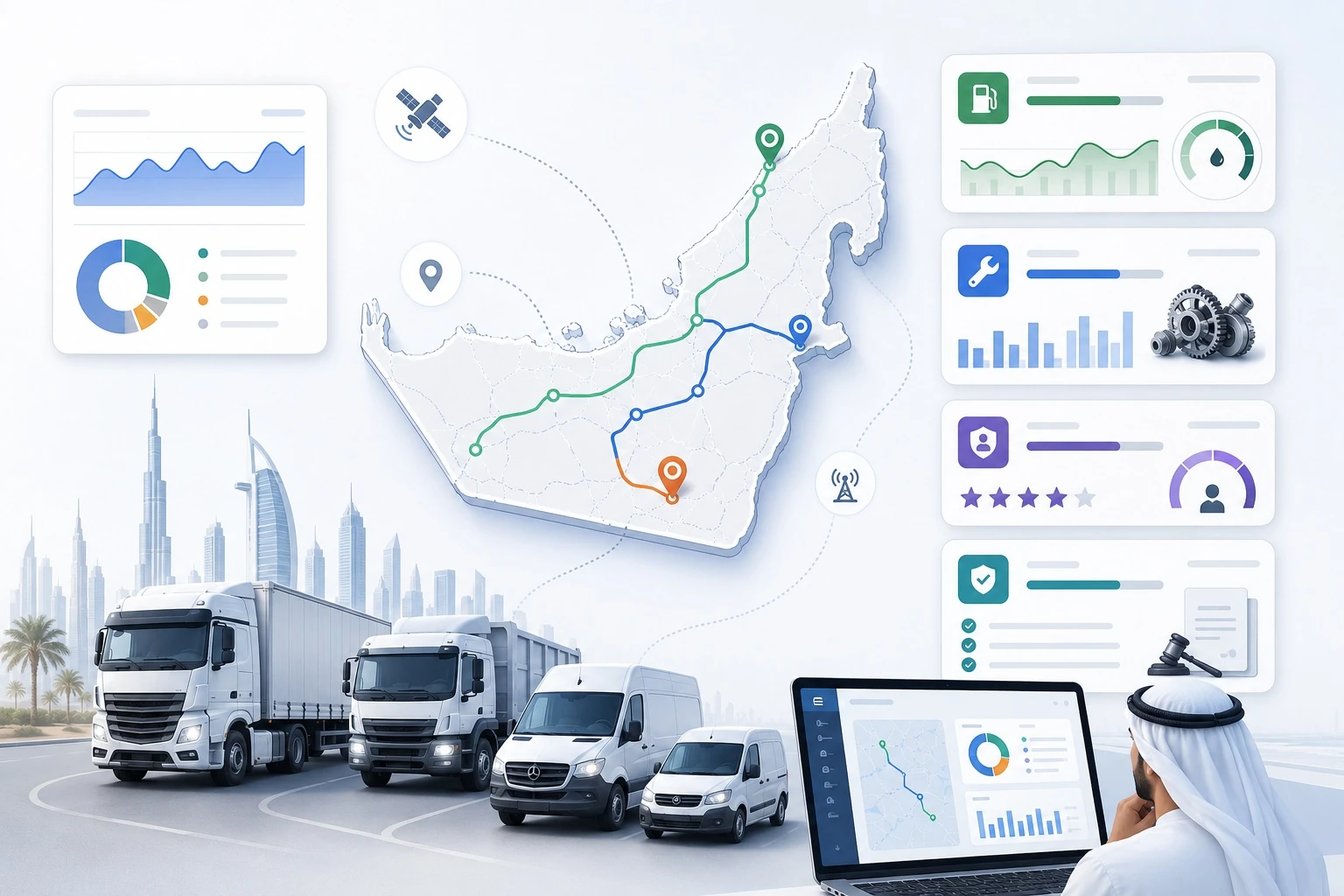
Fleet management challenges are the operational, financial, safety, compliance, and data problems that make it difficult to control vehicles, drivers, fuel, maintenance, routes, and service quality.
In the UAE, these challenges become even more complex because fleets often operate across Dubai, Abu Dhabi, Sharjah, and other emirates, while managing high delivery expectations, traffic, heat, compliance requirements, and growing transport costs.
For many companies, the problem is not only that vehicles are moving. The real problem is that managers do not always know where every vehicle is, how it is being driven, how much fuel is being used, when maintenance is due, whether documents are valid, and which part of the operation is losing money.
That is why modern fleet management is no longer just about vehicle location. It combines GPS tracking, telematics, driver behavior monitoring, fuel control, maintenance planning, compliance reporting, and business analytics in one connected system. For fleets that need more automated risk detection and smarter decision support, AI telematics can add predictive analytics, video intelligence, anomaly detection, and KPI-based recommendations.
The main fleet management challenges are rising fuel costs, driver safety, vehicle downtime, route inefficiency, compliance requirements, lack of real-time visibility, data overload, and disconnected business systems. In the UAE, these challenges are intensified by multi-emirate operations, traffic, harsh weather, heavy vehicle rules, and high customer expectations.
What Are Fleet Management Challenges?
Fleet management challenges are the recurring problems that prevent companies from running vehicles efficiently, safely, and profitably. These challenges usually include fuel waste, vehicle downtime, unsafe driving, route delays, compliance risks, manual reporting, poor visibility, and disconnected systems.
A small fleet may manage some of these issues with phone calls and spreadsheets. But once the number of vehicles, drivers, routes, and customers grows, manual control becomes unreliable. This is especially true for companies operating in the UAE, where commercial fleets often need to manage multi-emirate routes, strict service schedules, vehicle documentation, and heat-related maintenance risks.
Why These Challenges Are Different in the UAE
Fleet managers in the UAE deal with a specific combination of operational conditions. Vehicles may need to move between Dubai, Abu Dhabi, Sharjah, Ajman, Ras Al Khaimah, Fujairah, and Umm Al Quwain. Delivery vans, heavy trucks, service fleets, refrigerated vehicles, buses, and construction equipment all face different risks.
A company may have vehicles working in dense city traffic in Dubai in the morning, long-distance routes to Abu Dhabi in the afternoon, and industrial or construction sites by evening. At the same time, managers must control fuel use, driver behavior, maintenance, documentation, and customer communication.
The result is simple: without digital fleet visibility, small inefficiencies quickly become expensive.
1. Rising Fuel Costs and Fuel Misuse
Fuel is one of the largest controllable costs in fleet operations. Even when fuel prices are stable, poor driving behavior, long idling, route deviations, unauthorized vehicle use, leakage, theft, and inaccurate manual reporting can increase total fleet expenses.
In the UAE, fuel control is especially important for companies with delivery vans, heavy trucks, construction vehicles, refrigerated vehicles, and service fleets. A vehicle that idles for long periods in hot weather, takes longer routes, or operates outside approved hours can create hidden costs every day.
Fuel misuse is also difficult to detect without proper data. A manual fuel receipt may show how much was purchased, but it does not always show whether that fuel was used efficiently, wasted during idling, lost through leakage, or stolen.
How to Reduce Fuel Waste
Companies can reduce fuel waste by using GPS tracking, fuel level sensors, idling alerts, route optimization, and driver behavior reports. A proper fleet management system can show fuel consumption by vehicle, driver, route, and time period.
For fleets that need accurate fuel monitoring, TAI Capital provides fuel monitoring equipment that helps detect abnormal fuel drops, refueling events, and suspicious consumption patterns.
KPI to Track
- Fuel cost per vehicle
- Fuel cost per kilometer
- Idling time
- Fuel consumption by route
- Fuel consumption by driver
- Abnormal fuel drops
- Unauthorized after-hours movement
2. Driver Behavior and Road Safety
Driver behavior has a direct impact on safety, fuel use, maintenance costs, insurance risk, and company reputation. Speeding, harsh braking, aggressive acceleration, distracted driving, fatigue, and route violations can increase the risk of accidents and vehicle damage.
In the UAE, where fleets may operate in busy urban areas, highways, ports, industrial zones, and construction locations, driver monitoring is essential. Even one unsafe driving pattern repeated across multiple vehicles can result in higher repair costs, customer delays, fines, and serious safety risks.
How Driver Monitoring Helps
Modern telematics systems can detect speeding, harsh braking, sharp turns, rapid acceleration, long idling, and unauthorized use. Video telematics can add context by showing what happened before and after a road event.
Advanced systems may also include ADAS and DMS features. ADAS can help monitor road risks such as lane departure or forward collision risk. DMS can help detect signs of driver fatigue, distraction, or unsafe behavior inside the cabin.
TAI Capital also provides video surveillance and video telematics solutions for fleets that need stronger safety control, incident evidence, and driver coaching.
KPI to Track
- Accidents per 100,000 km
- Speeding events
- Harsh braking events
- Harsh acceleration events
- Driver safety score
- Repeat violations by driver
- Video-confirmed safety incidents
3. Vehicle Maintenance and Unexpected Downtime
Unexpected downtime is one of the most expensive fleet management challenges. When a vehicle breaks down, the cost is not limited to repairs. The company may also lose delivery time, customer trust, driver productivity, and revenue.
Maintenance problems often start small. A missed service interval, worn tyres, engine fault, low battery, brake issue, or overheating problem can become a serious breakdown if it is not detected early.
In the UAE, heat and long operating hours can increase stress on vehicles. Fleets that operate in construction, logistics, passenger transport, field service, or refrigerated delivery need a clear maintenance process to avoid avoidable downtime.
Preventive vs Predictive Maintenance
Preventive maintenance is based on schedules. Vehicles are serviced after a certain number of kilometers, engine hours, or calendar days.
Predictive maintenance uses vehicle data to detect early warning signs. It can combine mileage, engine hours, fault codes, temperature alerts, battery data, and maintenance history to predict when a vehicle may need attention.
KPI to Track
- Downtime hours
- Maintenance cost per vehicle
- Missed service intervals
- Repair frequency
- Mean time between failures
- Emergency repairs vs planned repairs
- Tyre replacement frequency
4. Compliance With UAE Transport Requirements
Compliance is a major fleet management challenge in the UAE, especially for transport companies, heavy vehicle operators, passenger transport providers, logistics fleets, and companies moving goods across emirates.
Fleet managers may need to control vehicle registration, insurance, inspection records, driver documentation, maintenance history, route records, permits, safety requirements, and heavy vehicle data.
For heavy vehicles, UAE authorities have introduced federal rules on weights and dimensions. The UAE Ministry of Energy and Infrastructure announced that the permissible maximum gross weight depends on the number of axles, with six-axle heavy vehicles reaching up to 65 tonnes. Fleet operators should always check current rules and official requirements before operating heavy vehicles on UAE roads.
Reference: UAE Ministry of Energy and Infrastructure — heavy vehicle weights and dimensions
Compliance Records Fleet Managers Should Keep
- Vehicle registration
- Insurance documents
- Inspection records
- Driver licenses
- Driver permits where required
- Maintenance history
- Incident reports
- Route records
- Fuel records
- Heavy vehicle documents
- Temperature logs for cold-chain fleets
How Fleet Software Supports Audit Readiness
Fleet management software can help companies store records, set renewal reminders, track inspections, monitor maintenance, and export reports when needed. Instead of searching through emails, paper files, and spreadsheets, managers can keep compliance data connected to each vehicle.
KPI to Track
- Expired documents
- Upcoming renewals
- Missed inspections
- Failed inspections
- Compliance tasks completed on time
- Fines or penalties
- Vehicles blocked from operation
5. Lack of Real-Time Fleet Visibility
A fleet manager cannot control what they cannot see. Without real-time visibility, teams rely on calls, messages, delayed reports, and driver updates. This creates problems when vehicles are late, routes change, customers ask for ETAs, or incidents happen on the road.
Real-time fleet visibility helps managers see vehicle location, movement status, trip history, driver activity, route deviations, unauthorized stops, and estimated arrival times.

Visibility Problems That Affect Daily Operations
- Late deliveries
- Missed service windows
- Unauthorized vehicle use
- Slow incident response
- Inaccurate ETAs
- Poor dispatch decisions
- Customer complaints
- Increased fuel costs
- Low vehicle utilization
KPI to Track
- On-time delivery rate
- ETA accuracy
- Unauthorized stops
- Route deviation
- Response time
- Vehicle utilization
- Trips completed per vehicle
6. Route Planning Across Dubai, Abu Dhabi, Sharjah and Other Emirates
Route planning is one of the most practical challenges in UAE fleet operations. A route that looks simple on a map may become inefficient because of traffic, loading times, customer delays, tolls, road restrictions, driver availability, or job sequencing.
For delivery fleets, poor routing can mean late orders and higher fuel consumption. For service fleets, it can mean fewer completed jobs per day. For heavy trucks, it can mean compliance issues, longer travel times, or restricted access.
How Route Optimization Solves the Problem
Route optimization helps managers reduce wasted kilometers, avoid unnecessary delays, improve driver scheduling, and provide better ETAs. A good system should allow dispatchers to see available vehicles, assign jobs, monitor progress, and adjust routes when conditions change.
KPI to Track
- Kilometers per job
- Late jobs
- Route deviation
- Empty miles
- Fuel cost by route
- Jobs completed per driver
- Average delivery or service time
7. High Customer Expectations and Delivery Pressure
Customers expect accurate ETAs, fast delivery, proof of service, and proactive communication. This applies to ecommerce, logistics, rental services, construction supply, field service, cold-chain delivery, and passenger transport.
When customers do not know where a vehicle is or when it will arrive, they contact the company. This increases pressure on dispatchers and customer support teams. If the information is inaccurate, trust is lost.
How to Improve Customer Communication
- ETA notifications
- Live tracking links
- Proof of delivery
- Digital job status updates
- Dispatcher dashboards
- Automated delay alerts
- Driver mobile workflows
KPI to Track
- Missed delivery windows
- Customer complaints
- First-attempt delivery success
- Repeat delivery attempts
- SLA compliance
- Average delay time
- Dispatcher calls per job
8. Data Overload Without Actionable Insights
Fleet systems can generate a lot of data. But more data does not automatically mean better management. If reports are too complex, disconnected, or not tied to decisions, managers may still miss the real problem.
Data overload happens when companies track many numbers but do not define which KPIs matter. A dashboard should not only show vehicle movement. It should help answer practical business questions:
- Which vehicles cost the most to operate?
- Which drivers create the highest safety risk?
- Which routes waste fuel?
- Which vehicles are underused?
- Which maintenance problems repeat?
- Which compliance tasks are overdue?
Turn Fleet Data Into Decisions
Fleet data should be organized around clear business goals: reduce fuel cost, improve safety, increase vehicle utilization, prevent downtime, meet compliance requirements, and improve service quality.
9. Integration With ERP, Accounting, Dispatch and Fuel Systems
Disconnected systems create hidden costs. If fleet data is separate from accounting, dispatch, ERP, fuel cards, HR, and maintenance systems, teams waste time entering the same information multiple times.
This can lead to billing errors, delayed reports, duplicate records, missed maintenance, incomplete cost analysis, and poor management visibility.
Systems Fleet Management Should Connect With
- ERP systems
- Accounting software
- Dispatch platforms
- Fuel card systems
- HR systems
- CRM
- Warehouse management systems
- Maintenance workshops
- Reporting dashboards
Platforms such as Wialon can support advanced fleet monitoring, reporting, hardware integration, and scalable telematics projects.
10. Driver Shortage, Retention and Training
Fleet performance depends on drivers. Hiring drivers is only one part of the challenge. Companies also need onboarding, safety training, fair scheduling, workload balance, communication, and performance management.
If drivers feel that routes are unfair, schedules are unclear, or performance reviews are based on opinion rather than data, retention can become difficult. Poor driver retention increases recruitment costs and disrupts operations.
How Technology Supports Driver Retention
- Fair route allocation
- Clear job instructions
- Driver scorecards
- Safety coaching
- Mobile communication
- Reduced paperwork
- Performance recognition
- Transparent workload data
11. Scalability as the Fleet Grows
A process that works for 10 vehicles may fail at 50, 100, or 500 vehicles. As a fleet grows, the company needs better user roles, reporting, permissions, integrations, hardware compatibility, support, and standard operating procedures.
Growth can expose weak processes. A company may suddenly realize that maintenance is not standardized, documents are not centralized, dispatch depends on one person, and reports are prepared manually.
Signs Your Fleet Has Outgrown Manual Management
- Vehicle locations are checked by phone
- Fuel costs are not linked to drivers or routes
- Maintenance is tracked in spreadsheets
- Document renewals are missed
- Dispatchers lack live visibility
- Reports take too long to prepare
- Driver performance is unclear
- Managers cannot calculate cost per vehicle
12. UAE Fleet Risk Map by Vehicle Type

Not every fleet has the same risk profile. A refrigerated vehicle, heavy truck, delivery van, bus, rental car, and construction vehicle all need different controls.
| Fleet Type | Main Challenge | UAE-Specific Risk | Recommended Control | KPI |
|---|---|---|---|---|
| Delivery vans | Late deliveries | Dense urban traffic and tight customer windows | GPS tracking, route optimization, ETA updates | On-time delivery rate |
| Heavy trucks | Compliance and maintenance | Heavy vehicle weight, dimensions, inspections, long routes | Compliance records, maintenance planning, route control | Downtime, failed inspections |
| Refrigerated vehicles | Cargo protection | Heat exposure and temperature-sensitive goods | Temperature sensors, alerts, trip reports | Temperature violations |
| Construction vehicles | Fuel misuse and utilization | Site-based work, idling, off-road movement | Fuel monitoring, geofencing, engine-hour tracking | Fuel cost per engine hour |
| Service fleets | Job scheduling | Multiple daily customer visits across emirates | Dispatch dashboard, job sequencing, driver app | Jobs completed per day |
| Rental fleets | Unauthorized use | Vehicle misuse, route deviation, delayed returns | GPS tracking, geofencing, movement alerts | Unauthorized trips |
| Buses | Passenger safety | Driver behavior and route discipline | Driver monitoring, video telematics, safety scoring | Safety events per route |
| Oil and gas fleets | Safety and asset security | Remote sites, high-value cargo, strict procedures | Tracking, video, geofencing, incident alerts | Route compliance |
13. 90-Day Plan to Fix Fleet Management Challenges
A company does not need to solve every fleet problem at once. The best approach is to start with visibility, identify the biggest losses, implement controls, and then build a reporting routine.
Days 1–15: Audit Fleet Costs and Data
Start by collecting vehicle lists, driver lists, fuel spend, maintenance records, insurance and registration documents, fines, mileage, routes, downtime, customer complaints, existing software tools, and manual reporting processes.
Days 16–30: Prioritize the Biggest Losses
Rank problems by financial and operational impact. For many fleets, the largest losses come from fuel waste, long idling, unexpected downtime, late deliveries, vehicle misuse, accidents, missed inspections, manual admin work, and underused vehicles.
Days 31–60: Install Tracking, Fuel and Safety Controls
Once the priorities are clear, install the right controls. This may include GPS tracking devices, fuel level sensors, geofencing, driver behavior alerts, maintenance reminders, temperature monitoring, video telematics, Wialon dashboards, and dispatch reports.
TAI Capital can help companies select hardware, configure Wialon fleet management, and build reports based on actual operating needs.
Days 61–90: Build Reports and Train the Team
Technology only works when people use it correctly. During this stage, fleet managers should train dispatchers, drivers, maintenance teams, and managers. Set up regular reports for fuel consumption, idling, safety events, vehicle utilization, maintenance status, compliance tasks, route performance, and cost per vehicle.
90-Day KPI Dashboard
| KPI | Baseline | 90-Day Target | Responsible Person | Review Frequency |
|---|---|---|---|---|
| Fuel cost per km | Current value | Reduce by 5–15% | Fleet manager | Weekly |
| Idling time | Current value | Reduce by 10–20% | Dispatcher | Weekly |
| Harsh driving events | Current value | Reduce repeat violations | Safety manager | Weekly |
| Downtime hours | Current value | Reduce unplanned downtime | Maintenance manager | Monthly |
| Late deliveries | Current value | Improve on-time rate | Operations manager | Weekly |
| Expired documents | Current value | Zero expired critical documents | Compliance officer | Weekly |
| Vehicle utilization | Current value | Increase productive usage | Fleet manager | Monthly |

How Fleet Management Software Helps Solve These Challenges
Fleet management software helps companies move from reactive control to proactive management. Instead of waiting for a breakdown, complaint, fine, or fuel discrepancy, managers can see problems earlier and act faster.
Tracking and visibility
Real-time GPS tracking, trip history, geofencing, vehicle status, and route deviation alerts.
Cost control
Fuel monitoring, idling reports, route optimization, maintenance planning, and cost-per-kilometer tracking.
Safety and compliance
Driver behavior analytics, video telematics, maintenance records, document reminders, and audit-ready reports.
A complete fleet management system can include real-time GPS tracking, trip history, fuel monitoring, driver behavior analytics, maintenance scheduling, geofencing, video telematics, temperature monitoring, compliance reminders, route optimization, dispatch tools, custom reports, and ERP integrations.
The value is not only in the software itself. The value is in how the system is configured for the company’s fleet type, routes, risks, and KPIs.
Features to Look For in a UAE Fleet Management System
- Real-time vehicle tracking
- Reliable GPS hardware
- Fuel sensor compatibility
- Wialon support
- Driver behavior reports
- Maintenance reminders
- Geofencing
- Video telematics options
- Temperature monitoring for refrigerated vehicles
- API integrations
- Custom dashboards
- Multi-vehicle and multi-branch support
- Local deployment support
- Scalable cloud infrastructure

When Should a UAE Business Upgrade From GPS Tracking to Full Fleet Management?
GPS tracking and fleet management are related, but they are not the same. GPS tracking shows where vehicles are. Full fleet management connects vehicle location with fuel use, driver behavior, maintenance, compliance, dispatch, reports, and cost control.
GPS Tracking Is Enough When…
Basic GPS tracking may be enough when a company has a small fleet and only needs to know where vehicles are, where they have been, whether they are moving or stopped, whether they entered or left a location, and basic trip history.
Full Fleet Management Is Better When…
A full fleet management system is better when a company needs to manage high fuel spend, multiple drivers, multi-emirate routes, heavy vehicles, refrigerated vehicles, compliance records, driver safety, maintenance schedules, customer ETAs, route optimization, video evidence, cost per vehicle, or integrations with business systems.
Conclusion: The Biggest Fleet Management Challenge Is Lack of Control
Most fleet management challenges come from the same root problem: lack of control. When managers do not have real-time visibility, reliable data, clear reports, and connected systems, they cannot control fuel costs, driver behavior, maintenance, compliance, routes, or customer service.
In the UAE, this challenge is even more important because fleets often operate across multiple emirates, vehicle types, customer locations, and regulatory requirements.
The solution is not only to install tracking devices. The solution is to build a complete fleet management process that connects vehicles, drivers, fuel, maintenance, safety, compliance, and business reporting.
Ready to improve fleet visibility and reduce operating costs?
TAI Capital helps companies implement fleet management systems, GPS tracking, fuel monitoring, video telematics, Wialon dashboards, and reporting tools for real fleet operations.
Request a Fleet Management ConsultationFAQ
What are the main fleet management challenges?
The main fleet management challenges are fuel costs, driver safety, vehicle downtime, route inefficiency, compliance requirements, lack of real-time visibility, data overload, maintenance planning, driver retention, and disconnected business systems.
What are the biggest fleet management challenges in the UAE?
The biggest fleet management challenges in the UAE include fuel control, traffic in Dubai and Abu Dhabi, multi-emirate routing, heat-related maintenance, driver behavior, heavy vehicle compliance, documentation, and high customer delivery expectations.
How can fleet managers reduce fuel costs?
Fleet managers can reduce fuel costs with fuel monitoring sensors, GPS tracking, idling alerts, route optimization, driver coaching, fuel consumption reports, and alerts for abnormal fuel drops or unauthorized vehicle use.
How does telematics help fleet management?
Telematics helps fleet management by collecting vehicle, location, driver, fuel, and maintenance data. This allows managers to monitor performance, reduce costs, improve safety, prevent downtime, and make faster operational decisions.
What is the difference between GPS tracking and fleet management?
GPS tracking focuses on vehicle location and trip history. Fleet management includes GPS tracking plus fuel monitoring, driver behavior, maintenance, compliance, dispatch, analytics, route planning, and cost control.
What KPIs should fleet managers track?
Fleet managers should track fuel cost per kilometer, vehicle utilization, idling time, downtime, maintenance cost, driver safety score, on-time delivery rate, compliance status, and total cost of ownership.
How can fleet software improve compliance?
Fleet software improves compliance by storing vehicle and driver documents, sending renewal reminders, tracking inspections, keeping maintenance records, recording incidents, and generating audit-ready reports.
When should a business use video telematics?
A business should use video telematics when it needs better driver safety, accident evidence, cargo security, passenger safety, driver coaching, or event-based video reports for risky road situations.