
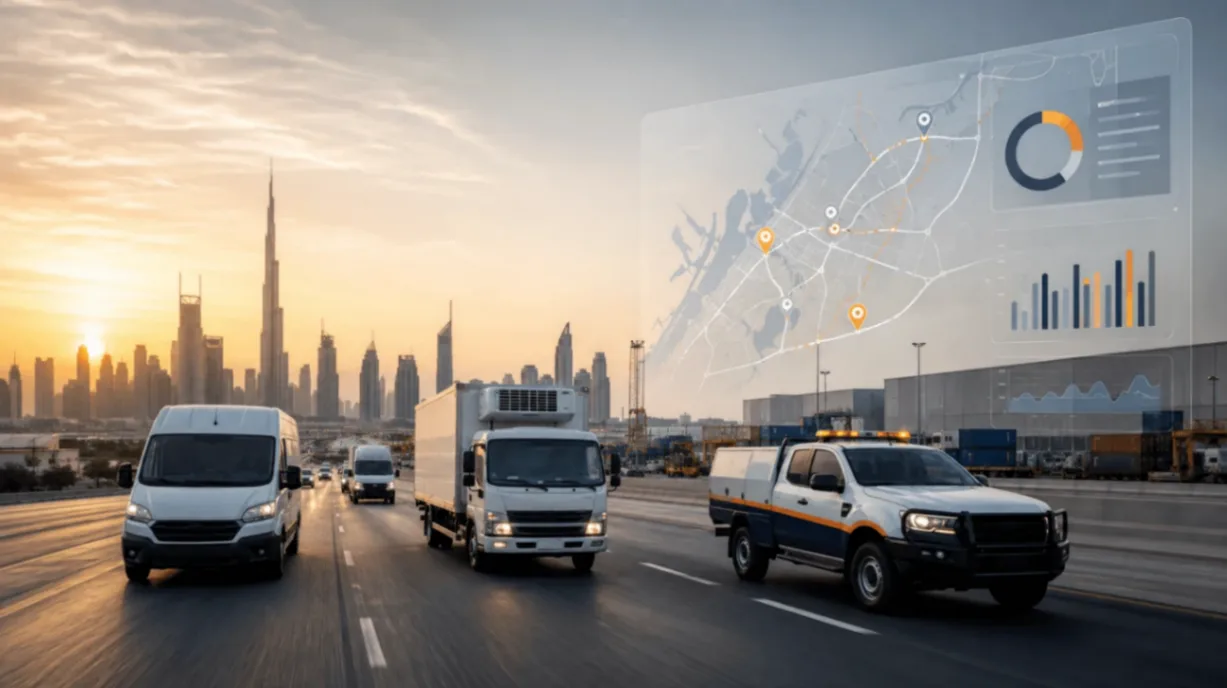
Fleet management is the coordinated control of business vehicles, drivers and mobile assets across their working life. It combines policies, people and technology to improve safety, vehicle availability, utilisation, fuel efficiency, maintenance, compliance and service quality. Modern fleet management software turns vehicle and driver data into alerts, reports and measurable actions.
Table of Contents
Every fleet is already managed. The real question is whether it is managed from evidence or from memory – from what vehicles and drivers actually did, or from phone calls, paper records and a spreadsheet that was last updated several days ago.
Fleet management is not the same as putting dots on a map. Vehicle location is useful, but a complete fleet management process also covers vehicle acquisition, driver safety, fuel, maintenance, compliance, utilisation, operating cost and business reporting. Technology supplies the evidence; people still decide what to do with it.
This guide explains what fleet management means, how a fleet management system works, which functions and KPIs matter, what software can automate, and how companies in the UAE can choose and implement the right solution.
Key takeaways
- Fleet management covers the full lifecycle of vehicles and mobile assets, not only GPS tracking.
- A fleet management system combines hardware, connectivity, software, sensors, integrations and operational workflows.
- The most useful systems connect each alert to a named action, owner and KPI.
- Benefits should be measured against a documented baseline, not assumed from supplier percentages.
- Fleet size matters less than operational complexity. A small multi-site or cold-chain fleet may need structured management earlier than a larger, simpler fleet.
- The right UAE fleet management solution must fit local vehicles, routes, connectivity, privacy requirements, climate and support needs.
What Is a Fleet?
A fleet is a group of vehicles or mobile assets operated or controlled by one organisation. It can include company cars, delivery vans, trucks, buses, taxis, trailers, tankers, construction machinery, generators, containers and non-powered equipment.
The assets do not all have to be owned. Many businesses operate a mixed fleet that combines owned, financed, leased and rented vehicles. Some also manage employee vehicles used for business travel or subcontractor vehicles that must follow company routes and safety rules.
A fleet can therefore be two service vans used by a maintenance company, hundreds of delivery vehicles working across several emirates, or a mixed operation containing trucks, trailers and heavy equipment. What makes it a fleet is common operational control, not a particular vehicle count.
What Is Fleet Management?
Fleet management is the coordinated planning, operation and control of vehicles, drivers and related assets from acquisition to disposal. Its purpose is to keep the fleet safe, available, compliant and cost-effective while supporting the service the business promises to customers.
The main goals are:
- Safety: reduce risky driving, incidents and preventable losses.
- Uptime: keep the right vehicles available when operations need them.
- Utilisation: avoid paying for assets that are rarely productive.
- Cost control: understand and manage fuel, maintenance, labour, insurance and depreciation.
- Service quality: improve dispatching, arrival visibility, route completion and customer communication.
- Compliance: maintain vehicle, driver and operational records required by the business and relevant authorities.
- Decision quality: give managers reliable data for replacement, maintenance, staffing and investment decisions.
Fleet management existed before telematics and can still be performed manually. However, modern commercial fleets increasingly use telematics and fleet management software because manual records become slow, incomplete and difficult to verify as operational complexity grows.
The Core Functions of Fleet Management

Different organisations group fleet management responsibilities differently. A practical model includes seven connected functions.
1. Vehicle and Asset Lifecycle
Lifecycle management covers vehicle specification, procurement, financing, registration, allocation, replacement and disposal. The cheapest vehicle to buy is not always the cheapest vehicle to operate. Managers need to consider payload, route type, fuel or energy use, maintenance support, expected utilisation, resale value and total cost of ownership.
2. Tracking and Fleet Operations
Operational management covers vehicle location, trip history, dispatch, routes, stops, job completion, unauthorised use and proof of service. GPS fleet tracking is part of this function, but it becomes more valuable when location data is connected with drivers, customers, schedules and operating rules.
For a deeper technical explanation, see What Is GPS Fleet Tracking?.
3. Drivers and Safety
Driver management includes identification, licence and document control, training, working policies, behaviour monitoring, coaching and incident investigation. Depending on the equipment installed, a system may record speeding, harsh braking, acceleration, cornering, idling, seatbelt events and camera-based safety alerts.
The purpose should be improvement, not surveillance for its own sake. Drivers need to know what data is collected, why it is used, who can access it and how long it is retained.
4. Fuel and Energy
Fuel management connects purchases and consumption with mileage, routes, idling, vehicle condition and driver behaviour. Depending on the project, the data may come from fuel cards, CAN bus, manufacturer integrations or calibrated fuel level sensors.
A detected increase in tank level can indicate a filling. A decrease can be normal consumption, a drain, a leak, sensor movement or another anomaly. Location and time add context, but no single event should be treated as proof of theft without investigation. Fleets with high fuel exposure can combine fuel monitoring equipment with tracking, reports and alert workflows.
5. Maintenance and Uptime
Maintenance management covers inspections, service schedules, defects, tyres, parts, repairs, warranties and downtime. Service rules may use calendar dates, mileage, engine hours, diagnostic data or a combination of these.
Vehicles working in heat, dust, heavy traffic, construction sites or other severe conditions may require the manufacturer’s severe-duty schedule and closer condition monitoring. Telematics can support planning, but it should not replace the vehicle manufacturer’s maintenance requirements or a qualified technical inspection.
6. Compliance and Records
Fleet teams manage vehicle registrations, driver documents, permits, inspections, incidents, maintenance histories and company policies. The required records depend on country, emirate, vehicle class and industry.
Location, driver and video data can also be personal data. UAE projects should be designed with access controls, defined purposes, retention rules and appropriate security. The UAE’s federal data-protection framework is described by the Official UAE Government portal. Companies operating in several countries should review each applicable regime instead of applying one policy everywhere.
7. Analytics and Integration
Fleet data becomes more useful when it connects with maintenance, ERP, accounting, dispatch, fuel, HR or business intelligence systems. Integration reduces repeated data entry and allows management to compare operating activity with cost and service outcomes.
The goal is not to collect every possible parameter. It is to create a reliable system of record that supports the decisions the business actually needs to make.
How Does Fleet Management Work?
A modern fleet management process follows a data-to-action cycle:

- Collect data. Vehicles, trackers, sensors, cameras, driver identifiers and business systems provide operational data.
- Transmit and store it. A telematics device normally sends data through a cellular network. Satellite communication may be used for specific remote operations. Devices with onboard memory can store records during coverage gaps and upload them later.
- Apply rules and analytics. The platform converts raw data into trips, stops, geofence events, fuel activity, safety events, maintenance reminders and reports.
- Trigger an action. A dispatcher contacts a driver, a maintenance planner creates a work order, a safety manager reviews an event, or finance investigates an unexpected cost.
- Review the KPI. Managers compare the result with the baseline and adjust rules, training or operational processes.
What Is a Fleet Management System?
A fleet management system is the connected set of tools used to collect, process and act on fleet information. In everyday use, the term is sometimes used only for the software platform, but a working system may include:
- GPS/GNSS trackers or manufacturer-provided vehicle data;
- cellular or satellite connectivity;
- onboard memory for temporary coverage loss;
- CAN bus, OBD, fuel, temperature, door, tyre or load sensors;
- driver identification devices;
- dashcams, MDVRs and ADAS/DMS equipment;
- cloud or on-premises fleet management software;
- desktop and mobile applications;
- reports, dashboards, alerts and user permissions;
- APIs and integrations with business systems;
- people, policies and response workflows.
This is why buying a tracker is not the same as implementing fleet management. Hardware captures data. Software organises it. A managed process determines who responds and how success is measured.
Fleet Management vs GPS Tracking vs Telematics vs TMS
| Term | Main purpose | Typical scope |
|---|---|---|
| Fleet management | Manage vehicles, drivers, costs, safety, uptime and compliance | The overall business discipline |
| Fleet management system | Support fleet processes with connected technology | Hardware, connectivity, software, integrations and workflows |
| GPS fleet tracking | Determine and report vehicle or asset location | Live position, trips, stops, routes and geofence events |
| Telematics | Collect and transmit remote vehicle and sensor data | Location, diagnostics, driver behaviour, fuel, temperature, video and other data |
| Transport management system (TMS) | Plan and manage freight or transport orders | Loads, orders, carriers, dispatch, rates, documentation and delivery workflows |
These systems can overlap and integrate. A logistics company may use a TMS to plan orders and a fleet management platform to show which vehicle executed each trip, how it was driven and what it cost.
Key Features of Fleet Management Software
The right feature set depends on the operational problem. Common capabilities include:
- real-time vehicle and asset tracking;
- route history, stops and trip classification;
- geofences for depots, customers, fuel stations and restricted areas;
- dispatch and route-control tools;
- fuel consumption, filling and potential drain analysis;
- driver identification and behaviour scoring;
- maintenance schedules and service-due alerts;
- video telematics and event-linked footage;
- temperature, door, tyre, load and equipment monitoring;
- document and renewal reminders;
- dashboards and scheduled reports;
- mobile access and user roles;
- APIs, data export and third-party integrations.
More features do not automatically create a better system. A fleet that needs reliable maintenance planning and fuel control may gain more from two carefully configured workflows than from dozens of alerts nobody reviews.

What Does a Fleet Manager Do?
A fleet manager coordinates vehicles, drivers, suppliers, maintenance, compliance and operational data. The exact role changes by industry, but a useful cadence looks like this:
| Cadence | Typical responsibilities | Questions to answer |
|---|---|---|
| Daily | Review critical alerts, vehicle availability, route exceptions, incidents and urgent defects | Which vehicles or jobs need action now? |
| Weekly | Review fuel anomalies, driver behaviour, upcoming services, recurring delays and open repairs | Which exceptions are becoming patterns? |
| Monthly | Analyse cost, utilisation, downtime, safety and supplier performance | Are fleet performance and operating cost improving against baseline? |
| Quarterly or annually | Review replacement plans, fleet size, contracts, policies, insurance and system configuration | Does the fleet still match business demand and risk? |
The role is not simply to watch a map. Strong fleet managers convert evidence into maintenance decisions, driver coaching, process changes and investment priorities.
Benefits of Fleet Management
Benefits should be connected to a mechanism and a KPI. This makes them measurable and prevents the business case from becoming a list of generic promises.
Better Fleet Visibility
Mechanism: live status, route history, geofences and exception alerts reduce the need for phone-based status checks.
Measure: dispatcher response time, proof-of-service availability, unplanned stops and route-completion rate.
Lower Fuel Waste and Better Fuel Control
Mechanism: compare fuel use with distance, idling, routes, vehicle history, fillings and potential drains.
Measure: fuel cost per kilometre, litres per 100 km, idle time and investigated fuel anomalies.
Improved Driver Safety
Mechanism: identify repeated risky events, provide evidence-based coaching and review incidents with vehicle or video data.
Measure: safety events per 1,000 km, speeding duration, preventable incident rate and coaching completion.
More Planned Maintenance and Less Unexpected Downtime
Mechanism: schedule service by date, mileage, engine hours or condition, and escalate overdue work.
Measure: planned versus unplanned downtime, breakdown frequency, maintenance compliance and vehicle availability.
Higher Vehicle Utilisation
Mechanism: identify underused assets, overlapping capacity and unbalanced assignments.
Measure: productive hours, productive distance, active days and idle-asset rate.
Stronger Customer Service
Mechanism: use route status, arrival evidence and operational history to improve communication and resolve disputes.
Measure: on-time completion, missed jobs, ETA accuracy and complaint-resolution time.
Better Management Decisions
Mechanism: combine fleet activity with cost, maintenance and service data.
Measure: total operating cost, total cost of ownership, cost per job and replacement performance.
Fleet Management KPIs and Formulas

Start with a small set of KPIs linked to the fleet’s current priorities. Define each formula, data source, reporting period and owner before creating the dashboard.
| KPI | Formula | What it helps reveal |
|---|---|---|
| Fuel cost per km | Total fuel cost / total distance | Fuel-cost trend by vehicle, route or fleet |
| Total operating cost per km | Operating costs / total distance | Whether pricing and asset decisions reflect real cost |
| Vehicle utilisation | Productive hours / scheduled available hours x 100 | Underused capacity or poor allocation |
| Idle time percentage | Engine-on idle time / total engine-on time x 100 | Avoidable fuel use and operating inefficiency |
| Unplanned downtime | Unscheduled out-of-service hours / scheduled available hours x 100 | Reliability and maintenance effectiveness |
| Maintenance cost per km | Maintenance cost / distance | Vehicle-specific cost deterioration |
| On-time completion rate | On-time jobs / completed jobs x 100 | Service reliability |
| Safety events per 1,000 km | Safety events / distance x 1,000 | Normalised driver or route risk trends |
| Fuel variance from baseline | (Actual consumption - baseline) / baseline x 100 | Change against the same vehicle's history |
| Total cost of ownership | Acquisition + financing + operating + downtime - resale value | Whole-life asset economics |
Compare like with like. A tipper on a construction site and a service van in city traffic should not share the same fuel baseline. In many cases, the most useful comparison is a vehicle against its own historical performance under similar operating conditions.
When Does a Business Need Fleet Management Software?
There is no universal vehicle-count threshold. The trigger is the point at which informal coordination can no longer provide reliable, timely information.
In TAI Capital’s implementation experience, many organisations begin to outgrow spreadsheets and direct personal knowledge somewhere around 15 to 25 vehicles. This is a practical planning range, not an industry rule. A five-vehicle cold-chain operation with temperature control, several drivers per vehicle and strict customer requirements may need structured software earlier. A simple local fleet may operate manually for longer.
Warning signs include:
- nobody can confirm a vehicle’s status without calling the driver;
- services are missed or completed early because records are unreliable;
- fuel spend rises without a clear vehicle, route or driver explanation;
- arrival-time disputes depend on memory rather than records;
- the same defects recur without a complete repair history;
- management reporting takes hours of manual consolidation;
- different branches maintain conflicting versions of the same fleet data.
Fleet Management by Industry
Different fleets require different combinations of hardware, software and workflow.
- Logistics and delivery: dispatch, routes, ETAs, proof of service, fuel and driver behaviour.
- Construction and heavy equipment: location, engine hours, utilisation, maintenance, fuel and unauthorised movement.
- Field service: nearest-vehicle visibility, customer visits, job completion and working-time evidence.
- Passenger transport: routes, driver safety, passenger-area video, schedules and incident investigation.
- Cold chain: temperature, door events, route compliance, alerts and audit history.
- Rental and leasing: utilisation, mileage, maintenance, unauthorised use and asset recovery.
- Fuel transport: route security, tank or vehicle data, video, driver identification and exception workflows.
- Agriculture and mining: engine hours, remote coverage, equipment utilisation, fuel and maintenance.
The system should be designed around the fleet’s highest-cost or highest-risk problems, not around the longest available feature list.
Fleet Management in the UAE

Vehicle fleet management in the UAE often combines dense urban operations, inter-emirate routes, industrial sites, high service expectations and mixed vehicle types. A delivery van in Dubai, a heavy truck moving between emirates and equipment working on a remote construction site have different tracking, maintenance and reporting needs.
Important design considerations include:
- Heat, dust and operating conditions: use suitable equipment and follow vehicle and device installation requirements.
- Multi-emirate operations: configure routes, depots, customer sites and reports around the real operating geography.
- Mixed fleets: verify compatibility separately for passenger vehicles, trucks, trailers, machinery and non-powered assets.
- Connectivity: confirm the network technologies and frequency bands used by the selected devices and operators. Use onboard buffering where temporary coverage loss is possible.
- Privacy and access: define why driver, location and video data is collected, who can view it and how long it is retained.
- Local implementation: installation quality, calibration, training and technical support can matter as much as the platform itself.
For a detailed review of cost, maintenance, safety, visibility and route-planning problems, see Fleet Management Challenges in the UAE.
Common Fleet Management Challenges
Fleet management projects commonly struggle with disconnected data, unreliable installation, excessive alerts, missing baselines, driver resistance and unclear responsibility for reports.
Technology alone does not solve these problems. The implementation needs agreed KPIs, documented policies, calibrated equipment, named users and a review process. The system must also evolve as routes, vehicles, customers and business priorities change.
How to Choose a Fleet Management System
Evaluate systems against operational requirements rather than a generic feature checklist.
- Define the business problem. Start with fuel, safety, uptime, dispatch, compliance, security or another measurable priority.
- Map the fleet. Record vehicle types, assets, drivers, routes, sites, networks and existing systems.
- Check hardware compatibility. Verify the exact tracker, sensor, camera and vehicle interfaces required.
- Review offline behaviour. Ask what is stored on the device during a coverage gap and how much history it can buffer.
- Test reporting and alerts. Confirm that users can turn data into the reports and workflows they actually need.
- Check data access. Review exports, APIs, permissions, retention and exit options.
- Review integrations. Identify which data must connect with ERP, maintenance, accounting, dispatch or BI systems.
- Model the full cost. Include hardware, installation, software, connectivity, integration, training and ongoing support.
- Assess local delivery. Confirm who installs, calibrates, trains users and resolves technical issues.
- Pilot before scaling. Test the configuration on a representative group of vehicles before full rollout.
Platforms such as Wialon support a wide range of devices and fleet workflows, while Wialon Hosting provides a cloud deployment model. TAI Capital can also use Titan and other technologies where they better fit the required workflow. Product selection should follow the operational assessment, not precede it.
Fleet Management Implementation Framework
A practical rollout can follow seven stages:
- Audit: document vehicles, processes, problems, systems and stakeholders.
- Baseline: record current fuel, downtime, utilisation, safety and reporting performance.
- Design: select hardware, connectivity, platform, rules, reports and integrations.
- Pilot: install on a representative group and validate data quality in real operating conditions.
- Train: explain policies to drivers and train dispatchers, managers and administrators.
- Scale: correct pilot issues before deploying across the fleet.
- Review: compare KPIs with baseline, remove low-value alerts and improve workflows.
Assign a named owner for every critical report or alert before installation. An alert without a response rule is only another notification.
What Does Fleet Management Cost?
Fleet management cost normally includes both one-off and recurring items.
| Cost category | Typical items |
|---|---|
| One-off | Trackers, sensors, cameras, installation, calibration, configuration, integration, data migration and initial training |
| Recurring | Software subscription, SIM/data, hosting where applicable, support and ongoing administration |
| Lifecycle | Replacement devices, repairs, recalibration, user retraining and integration changes |
There is no reliable universal price per vehicle because projects differ substantially. Basic vehicle tracking and a multi-camera, multi-sensor installation are not the same product. A useful quotation should specify hardware, installation method, reporting frequency, sensors, platform functions, integrations, support and contract terms.
How to Calculate Fleet Management ROI
Start with a measured baseline and calculate only the savings the system can reasonably influence.
Monthly gross savings may include:
- lower fuel cost;
- avoided downtime hours multiplied by the value of vehicle availability;
- reduced manual administration time;
- reduced overtime or disputed hours;
- avoided unnecessary vehicle hire or acquisition;
- other verified operating savings.
Net monthly savings = monthly gross savings – software subscription – connectivity – recurring support
Simple payback in months = total one-off implementation cost / net monthly savings
The one-off cost should include hardware, installation, configuration, integration and training. If net monthly savings are zero or negative, the project does not have a positive payback under that set of assumptions.
Insurance savings, fewer fines or lower accident costs may improve the business case, but they should not be treated as guaranteed. Confirm insurance terms with the insurer and use the fleet’s own incident and infringement history.
Any supplier quoting a precise payback period without asking about fuel spend, downtime, routes, labour and current losses is using a generic marketing estimate rather than the fleet’s business case.
The Future of Fleet Management
Fleet management is moving from separate monitoring tools towards connected decision-support systems. Important developments include AI-assisted video review, prioritised alerts, anomaly detection, predictive maintenance support, EV and mixed-energy reporting, and deeper integration between vehicles and business systems.
The objective should not be to generate more data. It should be to identify the events that require action and help managers respond faster. Read AI Telematics: Smarter Fleet Management Beyond GPS Tracking for a detailed explanation of AI, video analytics and predictive use cases.
How TAI Capital Supports Fleet Operations
TAI Capital designs and implements fleet telematics systems for commercial vehicles and mobile assets. A project can combine:
- GPS tracking equipment;
- fuel level and other connected sensors;
- vehicle video surveillance and video telematics;
- Wialon-based fleet management;
- Titan and other software platforms;
- dashboards, reports, alerts and user roles;
- API and business-system integrations;
- installation, configuration, training and technical support.
The starting point is a fleet needs assessment: vehicle types, operating regions, routes, risks, existing equipment, required KPIs and integration needs. This allows the technology and workflow to be designed around the business problem.
Conclusion
Fleet management is the discipline of controlling vehicles, drivers, assets, cost, safety, uptime and service performance across the fleet lifecycle. GPS tracking and telematics provide essential data, but the value comes from connecting that data to people, actions and measurable KPIs.
A successful system does not need every available feature on day one. It needs reliable data, clearly defined priorities, responsible users and a process for reviewing results. Start with the problems that cost the business the most, record the baseline, pilot the solution and expand only after the workflow is proven.
If your company is planning a new fleet management system or wants to improve an existing deployment, request a fleet assessment from TAI Capital.
Frequently asked questions
What is fleet management in simple terms?
Fleet management is the process of organising and controlling business vehicles, drivers and mobile assets. It covers purchasing, tracking, fuel, maintenance, safety, compliance, utilisation and operating cost.
What does a fleet manager do?
A fleet manager coordinates vehicle availability, maintenance, drivers, fuel, suppliers, compliance, cost and performance. The role involves daily exception handling, regular KPI reviews and longer-term decisions about fleet size and replacement.
What are the main functions of fleet management?
The main functions are vehicle lifecycle management, tracking and operations, driver safety, fuel or energy control, maintenance and uptime, compliance and records, and analytics and integration.
How does fleet management software work?
Fleet management software receives data from trackers, vehicles, sensors, cameras and business systems. It processes the data into maps, trips, alerts, maintenance reminders, dashboards and reports that users can act on.
What is the difference between fleet management and GPS tracking?
GPS tracking focuses primarily on vehicle or asset location, routes and movement history. Fleet management is broader and also includes drivers, fuel, maintenance, costs, compliance, utilisation and business processes.
What is the difference between telematics and fleet management?
Telematics is the technology used to collect and transmit remote vehicle and sensor data. Fleet management is the business discipline that uses telematics data together with policies, people and other systems.
What vehicles and assets can be managed?
A fleet system can manage cars, vans, trucks, buses, taxis, trailers, tankers, construction machinery, generators, containers and other powered or non-powered assets, depending on the selected equipment.
Can small fleets benefit from fleet management software?
Yes. Small fleets can benefit when they have high fuel exposure, several drivers per vehicle, multiple sites, customer time commitments, specialist sensors or expensive equipment. Operational complexity is a better trigger than vehicle count alone.
What KPIs should fleet managers track?
Useful starting KPIs include fuel cost per kilometre, total operating cost per kilometre, vehicle utilisation, idle time, unplanned downtime, maintenance cost, on-time completion and safety events per 1,000 kilometres.
How do you choose a fleet management system in the UAE?
Define the operational problem, map the fleet, verify hardware and network compatibility, test reports and offline behaviour, review data access and integrations, model total cost and confirm local installation and support.
How much does fleet management software cost?
Cost depends on the number and type of vehicles, trackers, sensors, cameras, installation, platform functions, data usage, integrations and support. Compare the full implementation and lifecycle cost, not only the monthly software fee.
How can fleet management reduce fuel and maintenance costs?
It can identify idling, inefficient routes, abnormal consumption, overdue service and repeated defects. The savings depend on whether managers investigate the data and change driver, maintenance or operational processes.
Need a practical fleet management system?
TAI Capital can assess vehicles, operating conditions, risks, hardware, connectivity, reports, integrations and support requirements.
Request a fleet assessment